

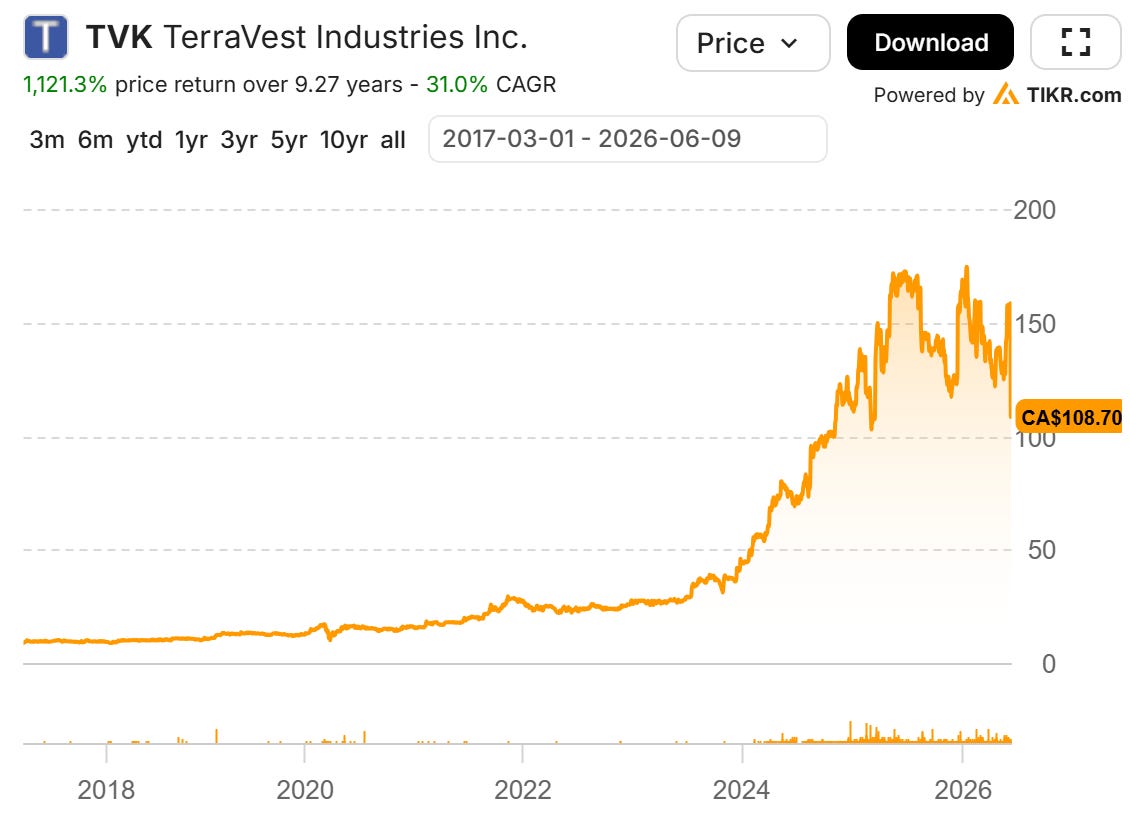
I have owned TerraVest Industries (TVK.TO) for over two years and followed the company closely for more than three, and a number of people have been in touch over the last few days to get my thoughts on what has happened. My view is that the 32% decline since the start of Friday trading reflects a significant governance event rather than any deterioration in the underlying business, although it will take time to earn back investor trust and to prove they can continue to execute in a world where Charles Pellerin no longer serves as the Executive Chairman. It is a troubling development, and one that raises real questions that will take time to answer, but with a strong and incentivised management team still in place, it is survivable, and I think the market's reaction feels overdone for an investor with a long-term orientation. I wrote a brief note on Friday outlining why I added to my position on the drop, and this piece sets out my thinking in more detail based on the limited information we have so far about the story.
The story broke on Friday that Quebec’s financial regulator, the AMF, alleges that executive chairman Charles Pellerin shared privileged information with nine family members and acquaintances ahead of TerraVest’s announcement of the EnTrans acquisition in March 2025. EnTrans was TerraVest’s largest ever deal by a considerable margin, a US$546 million acquisition of a premier North American tank trailer manufacturer that sent the stock from around C$109 to a peak of C$150 in the week following the announcement, reflecting how positively the market received the transaction at the time. The AMF estimates that the theoretical profits made by those individuals amounted to close to C$6.8 million. No charges have been filed. The board, excluding Pellerin, has commenced a formal review and stated it will cooperate fully with regulators. Based on that statement, this appears to be the actions of Mr. Pellerin alone rather than any wider failing within the company.
Before going further, just a note on the direction of the alleged trading. This is alleged inside buying ahead of positive news, not selling ahead of bad news. If the AMF’s account is correct, the implication is that Charles himself thought the EnTrans deal was a steal and acted accordingly, which is a different type of insider trade than say, an insider selling shares ahead of a profit warning, although it is not any less wrong, if true.
Losing Pellerin would be a very significant blow to TerraVest, and I think that needs to be said plainly. He is not a passive chairman in any sense of the word. Guy Gottfried of Rational Investment Group, who has followed TerraVest more closely than almost anyone outside the company, has described Charles as “a force of nature” and the architect of TerraVest’s M&A strategy, and from everything I have read and heard about how the company operates, that description rings true. When the Jerico business that Charles had built combined with TerraVest in 2014, he chose to take his entire consideration in TerraVest stock rather than cash, a decision that tells you a great deal about his conviction and his alignment. He has been hands-on ever since, instrumental in shaping the deal culture, the acquisition pipeline, and the strategic direction of the business. The investment case is certainly somewhat diminished by his potential departure even if everything else remains intact. These developments have been frustrating and costly for shareholders, and I am sure TVK insiders feel the same way.
The likely paths from here are reasonably clear.
(a) No wrongdoing is found and no charges are brought, in which case a decision still needs to be made about whether Pellerin remains as chairman. Given the nature of the allegations, I view this as the less likely outcome.
(b) The regulators find wrongdoing, in which case TerraVest will either decide or be compelled to remove Pellerin from the board, which I view as the more probable resolution.
There is also the separate question of Pellerin’s 15.7% stake. Should he exit the board he may choose to sell some or all of that position, creating meaningful overhang, or he may hold if he retains confidence in TerraVest’s long-term compounding ability.
There are further near-term risks worth naming. Law firms have already announced investigations into potential investor class actions, creating additional legal cost overhang and management distraction. The historical pattern with insider trading allegations at fundamentally sound businesses tends to involve six to twelve months of stock weakness and a governance discount that can persist for one to three years. That is the realistic timeframe to work with.
What gives me confidence is the quality of the team that remains. Dustin Haw became CEO of TerraVest in 2017, when he was in his early thirties. Dustin has compounded EBITDA per share at TVK at a rate of c.35% annually for eight years. He is analytical, disciplined in capital allocation, and has meaningful personal skin in the game. Mitch Gilbert, the CIO, spent fourteen years in M&A at a major Canadian bank before joining TerraVest in 2013 and has been central to the deal sourcing and execution that has driven value creation. Both have a long runway ahead and both appear untouched by the allegations. At the subsidiary level, John Jacob at Highland Tank and Ken Wagner and his team at Green Energy Services are entrepreneurs executing their own bolt-on strategies within the platform. The continued presence of these people should mean the compounding engine remains largely intact.
The table below captures just how exceptional the track record has been at TerraVest over the last eight years since Dustin became CEO, with shareholder returns to today’s C$108 stock price, not including dividends, which have grown from C$0.40 annually in FY17 to C$0.80 today.

Dustin has been central to TerraVest's capital allocation decisions throughout the period captured in the table above, and his incentives through equity remain fully intact. He is still in his early forties with what should be a long runway ahead as CEO at TerraVest.
So what are we paying today for TVK in the wake of the recent fall?
I value TerraVest on run-rate free cash flow rather than LTM figures, because the company completes so many acquisitions that trailing numbers consistently understate true earnings power. EnTrans, which is now a very significant part of the group, had a difficult year in 2025 due to softness in the tank trailer market, and the current numbers do not reflect its normalised earnings potential. Early data points for 2026 suggest the trailer market is beginning to recover, which should provide a meaningful tailwind to group earnings as the year progresses.
On a pro-forma revenue base of approximately C$1.85bn, accounting for full year contributions from all recent acquisitions, and applying TerraVest’s historical through-cycle free cash flow conversion of 10-11%, the business should generate approximately C$8 of free cash-flow per share.
At C$108 that is roughly 13.5x, against a peak of over 20x when sentiment was at its highest. Some compression is warranted given the governance overhang, but 13.5x for a business that has compounded EBITDA per share at c.35% annually over eight years feels like an overcorrection.
On the balance sheet, pro-forma net debt to run-rate EBITDA sits at roughly 2.6x. TerraVest has used a significant portion of its debt capacity over the past eighteen months, and with the equity issuance lever also impaired in the near term, another EnTrans-scale acquisition is unlikely in the short term. The more probable path is steady bolt-on compounding funded through operating cash flow, with more firepower rebuilding as earnings grow into the balance sheet.
In early May, TerraVest bought shares under its normal course issuer bid at C$117.50, a useful indication of where management saw value before last week’s events, with the stock now sitting below that level. My general rule of thumb with TerraVest to date has been to consider adding at or below 15x FCF and trim between 20x and 25x.
At C$80, or around 10x through-cycle free cash flow, I would be backing up the truck. At C$108 the stock looks attractively priced for a long-term investor and I added to my position at around that level. For someone not already in the stock this could be a reasonable entry point, though near-term volatility cannot be ruled out and my conviction is firmly in the medium to long-term picture rather than the next few weeks.
This is not a short-term trading call. It may take time for TerraVest to earn back the premium multiple it had been trading at, since that premium reflected confidence in the acquisition runway and the team’s ability to continue allocating capital at high rates of return. That confidence has been shaken and will need to be rebuilt through consistent execution and clarity on the Pellerin situation. Losing Charles is a genuine blow, and I do not want to minimise that. But with Dustin, Mitch and the broader team still in place, incentivised and with long runways ahead of them, I believe TerraVest has what it needs to continue compounding capital. The time to buy long-term compounders is when they are out of favour, and these developments have produced exactly that kind of opportunity.
Disclaimer: This is not financial advice and only for informational purposes. I hold a position in TerraVest Industries. Do your own research.
Overreaction or not, this is still a huge red flag. The AMF doesn’t launch investigation for no reason. He may be a good capital allocator and have a solid growth road map, but this clearly highlights a huge flaw in terms of governance. I wouldn’t touch this company despite being a good compounding machine. We’ll see how it plays out, but governance issues like these shouldn’t be ignored. Cheers!